
Monsters of Misogyny in Men (2022)
- Grace Deboer
- Apr 13, 2023
- 6 min read

Updated: Apr 14, 2023
Grace DeBoer
(TW: Spoilers, mentions of abuse, sexual assault, suicide, imagery of body gore)
What’s your biggest fear? Heights, spiders, the dark, even death? For Harper, it’s men.
In Alex Garland’s 2022 film, Men, audiences experience a disturbing story that follows Harper’s haunting experience in the English countryside, where she is harassed, tortured and abused by men. When analyzing Men, it's hard to ignore its discussions of gender. The title even alludes to gender identity, and although there are clear indications that the story involves Harper experiencing the five stages of grief following an extremely traumatic event, I argue that there is an even stronger theme of the cycle of toxic masculinity and misogyny at work – because horror hates women.
Film posters of Men 2022
If that seems a bit harsh – maybe horror doesn’t hate all women, but it does hate women who have sex, and it creates strict archetypes for female characters. As Alyssa Miller explains it, “Female characters have existed to serve the development of the main character, typically a male, through the lens of the manic pixie dream girl, the advice-giving best friend, a trophy for a hero, a damsel in distress, and many other played-out, one-dimensional characters” (Miller 2021). Female characters are brutally murdered in horror films, because they are helpless, or maybe even just because they are having sex. "Sexually deviant characters" aka non-virgins, somehow deserve to die in horror films. Some horror films even portray forms of torture porn. Filmmakers of those films and their audiences seem to enjoy the abuse of sexually active women.
It’s interesting, then, to think about this strange obsession with virginity in horror, let alone in media. “A slut, a bitch, a tease or the virgin next door,’’ are the limited roles that women play in horror films, according to Katharine Isabelle, the protagonist of the 2000 horror flick, Ginger Snaps (Stewart 2020). In horror, the innocent, virginal girls survive. The final girl is another archetype that fails women. This fierce female character can survive in a horror, but this archetype is anything but empowering. The final girl is either a virgin or has masculine traits that make her strong and powerful. She has to act like a man to survive. This is backward as well.
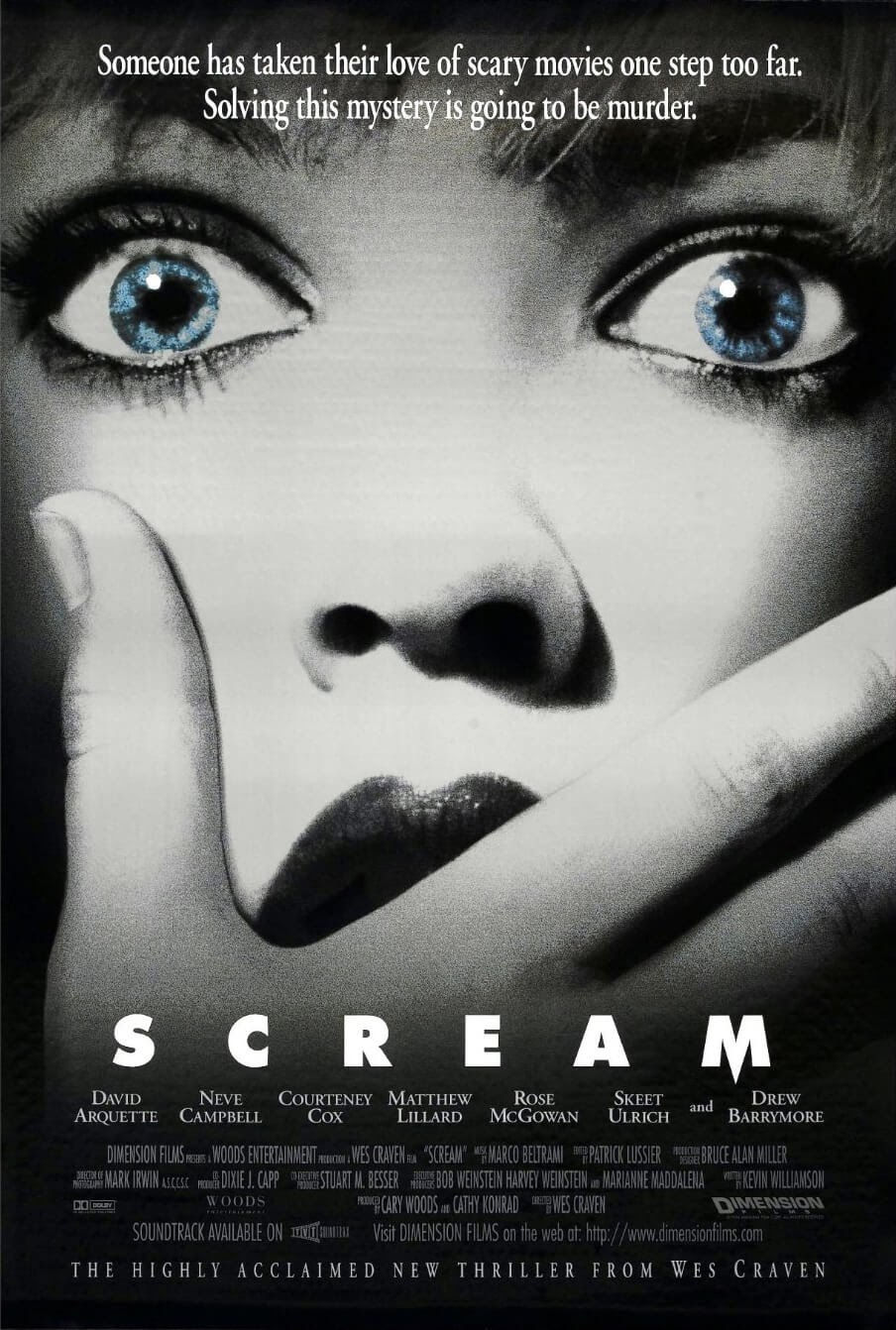
Scream 1996 Film Poster
Although Men is a horror movie, it avoids the typical gender archetypes. Harper is certainly a survivor in this film, but she lacks the qualities of a final girl since she is one of the only women in the entire movie. I don’t find that Harper fits into any of these archetypes, actually, and I think this is purposeful. She has just experienced the very intense death of her husband and is struggling with PTSD. As she tries to overcome her grief and guilt, she is met with many hindrances - all taking the form of men - trying to blame her for the actions of her husband.
Although it is unclear which events and characters are real throughout the film, each male character serves to play a key trait of toxic masculinity. Rather than Harper, it's the men who portray archetypes in this film. The characters I want to dissect here include Geoffrey the homeowner, Samuel the creepy kid, the vicar, the police officer, the naked man-turned-green man and Harper’s husband, James.
Geoffrey
Geoffrey seems to be friendly – he’s the type of man to call himself a “nice guy.” He represents how men see women as weak and damsels in distress, as he immediately insists on taking all of Harper’s belongings into the house, without her help, even though he struggles to do so. He again acts “chivalrous” by forcing Harper to let him pay for her drink at the pub, and finally, he insists on being brave and checking out what is going on outside her house – which ultimately leads to his loss of sanity.
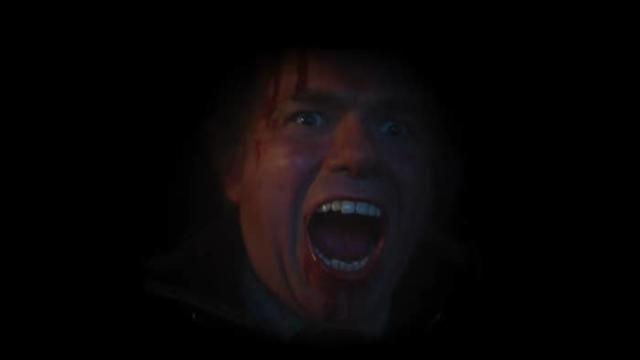
Geoffrey, after losing his sanity and aiming to hit Harper with her car
Samuel
Samuel represents how misogyny is engraved in men from a young age. He is obviously a troubled boy, wearing a women’s mask over his face and asking Harper to play hide and seek creepily outside of the church. When Harper declines, he calls her a “stupid bitch” (Garland 2022). He is just a kid, and we can presume children shouldn’t use this language, or think of women in such a horrible way at this age. He has been taught to treat women as objects, most likely by other men in his life.

Samuel, wearing a woman's mask
The Vicar
The vicar is a horrifying character, representing repressed sexuality and an incelibate male character. He blames Harper for James’s death and shoves the patriarchal beliefs of the bible and church onto her when she confided in him about her troubles. In the end, he tries to sexually assault her, claiming that he has sexual fantasies about her and that it is her fault he feels that way.

The vicar speaking with Harper outside the church
The Police Officer
The police officer represents the misogynistic belief of victim blaming. As an authority figure, his character alludes to male power in the government and structured systems in our society that enforce the patriarchy. He gaslights Harper in the pub, trying to convince her that the naked man she saw was not actually stalking her or causing any harm, so they let him go after arresting him earlier when she had called in distress. He and the other men in the pub laugh off the incident, but to Harper – and the audience full of women – this feeling of not being seen or heard stings painfully. The officer places blame on Harper again, adding to her already disturbed guilty conscience.

The police officer at the pub
The Naked Man/Green Man
The naked man and his transformation is arguably the most confusing and chilling part of the film. He is something to fear – a monster from the first time we see him on screen – stalking Harper and trying to break into her home. We watch him turn into a creature throughout the film until he fully mutates into the green man, a pagan folklore figure. The green man, according to Scarlett Ravenswood, is primarily interpreted as a symbol of rebirth and reincarnation, even seen as a symbol of fertility. That’s right, a man is the symbol of fertility and birth! Men uses this symbolism literally in the film, as the green man gives birth to each man that tortures Harper. In this sequence, Men displays how “the horrors of misogyny are born into each subsequent man to the point where they are indistinguishable from each other” (Hutchinson 2022).

The naked man transforms into the green man
James
Though the film does not specify exactly if James slipped or let himself fall from the balcony, I assume that James did intentionally kill himself. James personifies domestic abuse. In the red-lit flashback scenes, we see glimpses of Harper and James’s final fight. Harper is begging James for a divorce. We can assume that their relationship has been previously abusive as Harper expresses that she feels scared of him to a friend, a text James reads and then immediately hits Harper in the face… proving her point. Just before this incident, he had threatened Harper with his suicide if she divorced him, trying to put the blame onto her. When Harper kicks him out after hurting her, he breaks into the apartment above theirs, and Harper has one more look at him as he falls to his death outside of their balcony. Harper finds his body, in a disarranged position, ankle broken and hand split open by a spoke he landed on – mirroring the injuries the shapeshifting male monster has towards the end of the film. In the final, extremely disturbing birthing sequence of the film, James is the final rebirth of men. James again tries to blame Harper for his injuries.

James falling to his death
[last lines]
James: Look at me, Harper.
[She turns to face him]
James: So I died. My arm was ripped through by an iron railing. My ankle snapped, my internal organs crushed. This is what you did.
Harper: James... what is it that you want from me?
James: Your love.
Harper: [sighs] Yeah.
(Garland, 2020)
As Antonio Alexander explains in his video analysis of the film, this dialogue exchange can show Harper’s acceptance that she is not to blame for James’s death, as when she gave him one last opportunity to apologize to her, he still blamed her. Although James had the opportunity to break the toxic cycle at this point, I think he proves to Harper that men will continue to disappoint and abuse her, regardless of her actions, and it is not her job to end that vicious cycle. She is not a final girl trope, instead, she is a woman who has found peace, even in the company of cruel male archetypes.

Harper, ready to fight
References
Alexander, A. (2022, June). Men (2022) Explained + Analysis. Www.youtube.com. https://www.youtube.com/watch?v=M3CGWEfcG6U
Garland, A. (Director). (2022, May 20). Men [Film]. A24.
Hutchinson, C. (2022, May 20). “Men” Ending Explained: Time to Decode Some Metaphors About Masculinity! Collider. https://collider.com/men-ending-explained-alex-garland-jessie-buckley-rory-kinnear/
Miller, A. (2021, August 9). Girlhood to Monstress: How Women in Horror Have Always Been the Hero and the Villain. No Film School. https://nofilmschool.com/women-as-hero-and-villain-in-horror
Ravenswood, S. (2020). Who is The Green Man? || Paganism 101. Www.youtube.com. https://www.youtube.com/watch?v=7sC6nne46gw&t=9s
Stewart, A. (2020, October 16). Women in Horror Cinema: “Screen Queens” and changing representations. STAND. https://stand.ie/women-in-horror-changing-representations/
Comments